
Technology should make operations simpler, not more complicated.
SaberBMS was designed to replace time-consuming manual battery checks with an automated monitoring system that gives businesses greater visibility across their fleet.
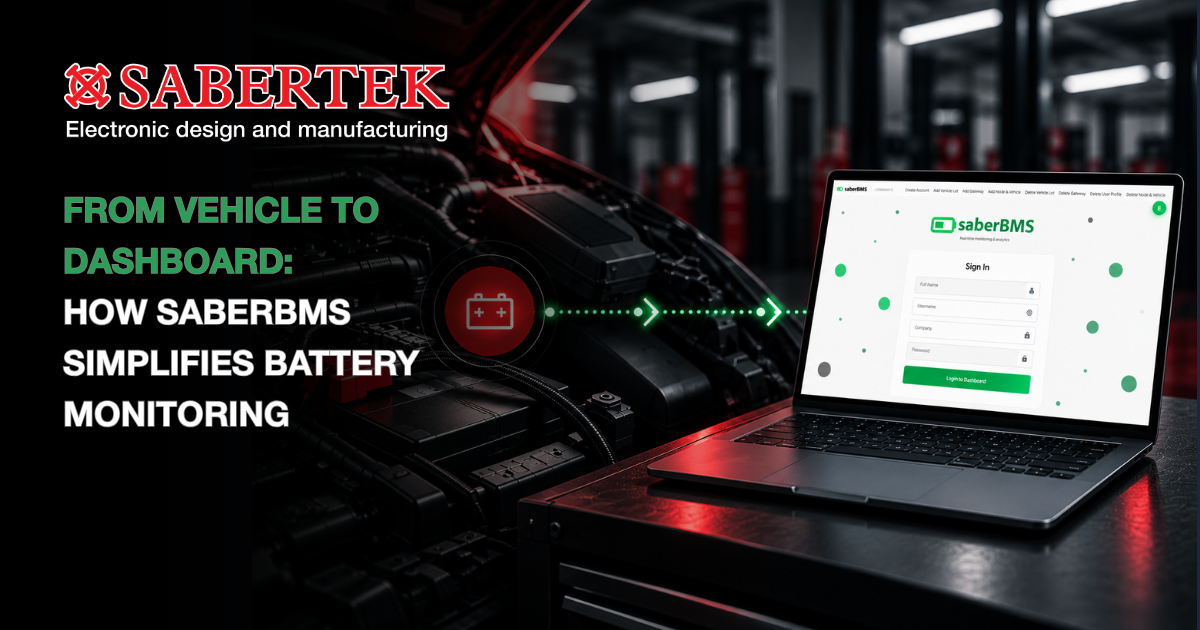
From the vehicle battery to a central dashboard, SaberBMS creates a simple flow of information that helps maintenance teams monitor battery condition and identify potential problems earlier.
How Does SaberBMS Work?
The SaberBMS system connects the vehicle battery, SaberBMS Node, Gateway and Dashboard to automatically collect and display battery voltage information.
Step 1: Connect the Vehicle
A SaberBMS Node connects directly to the vehicle battery using isolated battery clamps.
The node measures battery voltage and transmits the data at configurable intervals using open-band RF communication. Each node is powered by its own internal battery.
Step 2: Collect the Data
The SaberBMS Gateway collects information from all nodes within range.
This information is then forwarded via Wi-Fi to a secure server, removing the need for technicians to manually capture and transfer individual battery readings.
Step 3: View the Information
Battery information is brought together in one central Dashboard, giving users access to:
- Battery voltage information
- Historical battery data
- Centralised fleet visibility
- Low battery voltage alerts
Instead of relying on individual manual records, maintenance teams have battery information available in one central view.
Simple Vehicle Pairing
Deploying SaberBMS has been designed to be straightforward.
Each SaberBMS Node has a unique serial number that is paired with the vehicle’s VIN or identification number.
The process is simple:
- Scan the vehicle VIN
- Scan the SaberBMS Node ID
- Pair the vehicle and node
- Begin live monitoring
Once paired, battery information is automatically linked to the correct vehicle until the node is reassigned.
What Happens When a Vehicle Leaves?
Fleet requirements constantly change. Vehicles may leave the yard, be replaced or move between operations.
SaberBMS Nodes can easily be reassigned:
- Vehicle leaves
- Unpair the SaberBMS Node
- Assign the node to the next vehicle
- Continue monitoring
This allows the system to adapt as fleet requirements change without requiring a dedicated node to remain permanently attached to one vehicle.
More Than Battery Monitoring
The value of SaberBMS extends beyond simply measuring battery voltage.
By automating the monitoring process, businesses can benefit from:
- Automatic monitoring – Battery voltage is captured automatically at configurable intervals.
- Centralised visibility – Vehicles can be monitored from one Dashboard.
- Early detection – Low batteries can be identified before they fail.
- Accurate and reliable data – Automated data reduces manual recording errors.
- Historical information – Battery voltage trends can support proactive maintenance.
- Easy deployment – Simple installation requires minimal training.
- Scalability and flexibility – Nodes can be reassigned as vehicles change.
Turning Better Data Into Better Decisions
Automated battery monitoring can help reduce the labour associated with manual battery inspections and data capture.
With greater visibility into battery condition and historical trends, maintenance teams can make more informed decisions, plan maintenance proactively and use their resources more efficiently.
For businesses managing vehicle fleets, this can contribute to reduced labour costs, lower battery replacement costs, increased operational efficiency and improved asset protection.
Smarter Monitoring Starts With Better Visibility
SaberBMS transforms battery monitoring from a repetitive manual process into an automated, connected system.
From the battery-mounted node to the Gateway and central Dashboard, each component works together to make battery information easier to collect, access and use.
Less manual checking. Better visibility. Smarter maintenance.
SaberBMS. Automated. Wireless. Intelligent.